⚡ TL;DR for Defenders
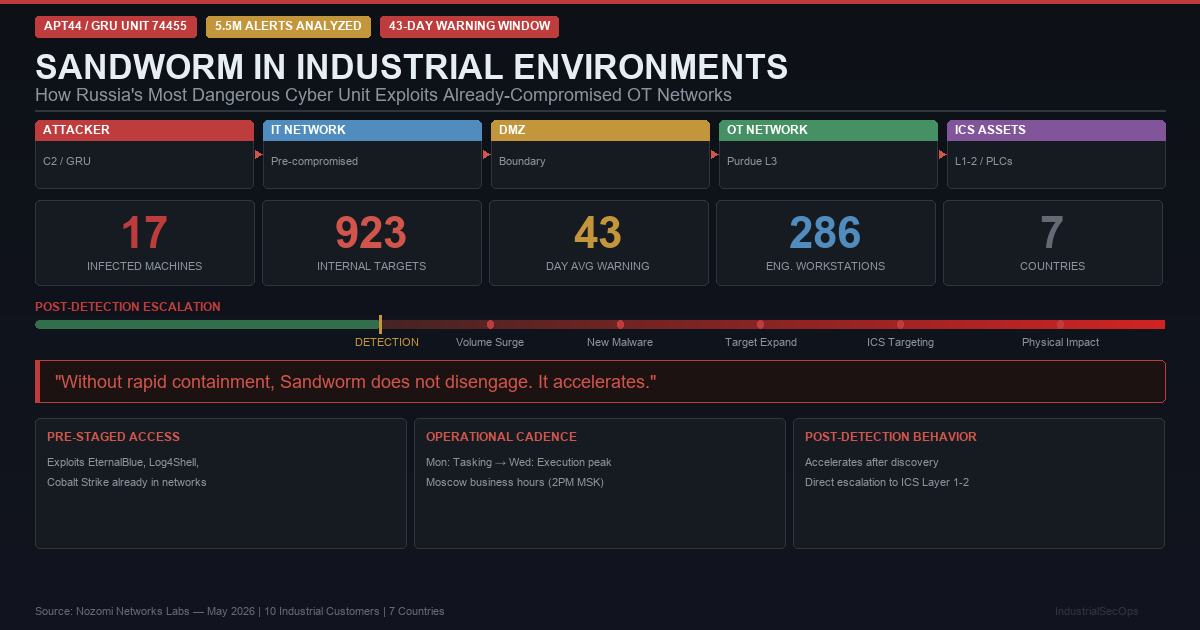
Sandworm (APT44/Seashell Blizzard), Russia’s GRU Unit 74455, was detected exploiting pre-compromised industrial environments across 10 organizations in 7 countries. The group does not rely on zero-day exploits — it capitalizes on existing infections including EternalBlue, Log4Shell, and Cobalt Strike. Every infected system generated an average of 43 days of advance warnings that went uninvestigated. Most critically, Sandworm escalates after detection rather than retreating, shifting focus directly toward ICS assets including PLCs, RTUs, HMIs, and engineering workstations.
Every Sandworm-infected industrial system in a new study gave defenders an average of 43 days of advance warning. None of them were investigated.
That’s the central finding from Nozomi Networks’ deep analysis of Sandworm activity across 10 industrial customers in seven countries — the first quantitative study of how Russia’s most destructive cyber-sabotage unit operates inside OT environments. Published May 13, 2026, the research draws on 5.5 million alerts from manufacturing and transportation organizations in the U.S., Mexico, U.K., Germany, Belgium, Colombia, and Thailand, spanning July 2025 through January 2026.
The results challenge a common assumption about advanced persistent threats: that state-sponsored actors use sophisticated, novel techniques to breach their targets. Sandworm does not. It moves into environments that are already compromised — and then it escalates.
What Happened
Nozomi Networks analyzed anonymized telemetry consisting of 5,543,865 alerts collected from 10 industrial customers across seven countries. These organizations operate in the manufacturing and transportation sectors, including pharmaceuticals, food production, motor vehicles, computer equipment, and textiles.
Of the total alert volume, 1,141,348 alerts (20.6%) originated from ICS-classified source assets — engineering workstations, field controllers (RTUs, PLCs, IEDs), and human-machine interfaces. Within this corpus, 29 events were conclusively identified as Sandworm activity using signature-based detections, including YARA rules and validated threat intelligence indicators.
The 17 Sandworm-infected machines identified across the 10 customers conducted lateral movement against 923 unique internal targets. In the most extreme case, a single infected system attempted lateral movement against 405 internal targets. One infection event triggered a 12-fold increase in alert volume.
Technical Breakdown
Pre-Existing Compromise as a Launch Pad
The pattern was consistent across all victims: systems compromised by Sandworm were already heavily infected before Sandworm activity began.
- Three victims with the widest lateral movement already showed active EternalBlue → DoublePulsar → WannaCry exploit chains
- Four victims had ongoing command-and-control activity using Cobalt Strike, Metasploit, and other Remote Access Trojans
- Three victims experienced a second wave leveraging Log4Shell as the initial access vector
Sandworm did not need novel exploits. It simply capitalized on environments that were already “owned.”
Bureaucratic Execution Model
Activity strongly correlates with standard Russian government working hours, peaking midweek (Wednesday at approximately 2:00 PM Moscow time) and following a predictable pattern: Monday tasking stabilization, Tuesday coordination, Wednesday execution begins in earnest, Thursday–Friday reporting and cleanup.
During the timeline overlapping with the attributed Polish power grid attack, Sandworm’s acquisition rate of new victims decreased by approximately 2.2x — averaging one new victim every 24.7 days versus the prior pace of one every 11.4 days — suggesting resource reallocation toward that operation.
Post-Detection Escalation
In every affected environment, Sandworm activity intensified after detection across multiple dimensions simultaneously:
| Escalation Dimension | Observed Behavior |
|---|---|
| Alert Volume | Daily alert rate increased post-detection |
| Alert Type Variety | More distinct alert categories fired |
| Threat Diversity | New malware and threat identifiers deployed |
| New Attack Types | Previously unseen alert types appeared |
| Target Expansion | More unique destination IPs contacted |
| Port Expansion | More destination ports probed |
| MITRE Danger Shift | Tactics shifted toward Impact and Inhibit Response |
Most victims experienced escalation across 4–6 out of 7 dimensions simultaneously, indicating coordinated post-detection adaptation.
⚠️ Direct ICS Targeting Confirmed
ICS assets were explicitly targeted after escalation: 286 engineering workstations at one victim, 102 at another, 52 field controllers (RTUs, PLCs, IEDs) at one victim, and 95 HMIs at another. The targeting of Purdue Level 1 and Level 2 assets confirms deliberate OT-specific intent.
Who Is Affected
Any organization running industrial control systems, particularly in manufacturing and transportation. The study documented victims in:
- Sectors: Pharmaceuticals, food production, motor vehicles, computer equipment, textiles, transportation
- Countries: United States, Mexico, United Kingdom, Germany, Belgium, Colombia, Thailand
- At risk: Any facility with unresolved EternalBlue, Log4Shell, or active C2 frameworks in their environment
Why This Matters
Sandworm Is Not a Conventional Threat
Sandworm stands apart from all other threat actors because it combines three characteristics no other group shares simultaneously:
- State-directed military mission focused on disruption and physical impact (not profit or espionage)
- Deliberate ICS targeting — it doesn’t stop at IT; it specifically pursues PLCs, HMIs, and engineering workstations
- Post-detection escalation — rather than retreating when discovered, it accelerates
History of Destructive Impact
| Year | Operation | Impact |
|---|---|---|
| Dec 2015 | BlackEnergy | First cyber-induced blackout — 230,000 customers affected |
| Dec 2016 | Industroyer / CRASHOVERRIDE | Second Ukrainian power grid attack using purpose-built OT malware |
| Jun 2017 | NotPetya | Destructive wiper — billions in global damages |
| Apr 2022 | Industroyer2 | Attempted power disruption during Ukraine war |
| 2025 | Ongoing campaigns | Ukrainian energy/water targets + attributed Polish grid attacks |
The 43-Day Warning Window
🔑 Key Insight
Every Sandworm-infected system produced 20 to 155 days of warning alerts prior to Sandworm activity. Average: 43 days. Investigating any of these alerts — EternalBlue, Cobalt Strike, RAT activity, or Log4Shell — would likely have revealed compromised systems before Sandworm arrived. These were not stealthy zero-day attacks. These were noisy, well-documented techniques that went uninvestigated.
MITRE ATT&CK for ICS Mapping
| Tactic | Technique | Sandworm Application |
|---|---|---|
| Initial Access | T0866 — Exploitation of Remote Services | Leveraged pre-existing EternalBlue and Log4Shell compromises |
| Execution | T0871 — Execution through API | Cobalt Strike and Metasploit beacons for command execution |
| Lateral Movement | T0886 — Remote Services | Aggressive scanning of 923 internal targets from 17 machines |
| Discovery | T0846 — Remote System Discovery | Port expansion and service enumeration post-detection |
| Collection | T0802 — Automated Collection | Systematic targeting of engineering workstations |
| Inhibit Response | T0816 — Device Restart/Shutdown | MITRE danger score shifted toward Inhibit Response post-detection |
| Impact | T0882 — Theft of Operational Information | Targeting HMIs and field controllers for process data |
Defensive Recommendations
Immediate (0–30 days)
- Audit for commodity compromises NOW: Search for active EternalBlue, DoublePulsar, WannaCry, Log4Shell, Cobalt Strike, and Metasploit indicators across IT and OT networks. Any finding is a potential Sandworm launch pad.
- Investigate “routine” alerts: Stop treating known exploit chain alerts as noise. Every Sandworm victim had weeks of advance warnings that were ignored.
- Isolate compromised systems immediately: Do not attempt partial remediation. Sandworm adapts to incomplete containment.
Short-Term (30–90 days)
- Enforce IT/OT segmentation: Validate that lateral movement from IT to OT is blocked at the network level. Sandworm’s primary tactic is internal expansion.
- Harden engineering workstations: These are Sandworm’s primary OT targets. Remove them from general-purpose IT tasks, disable internet access, and apply heightened monitoring.
- Deploy OT network monitoring: Detect abnormal internal scanning, unusual authentication attempts, and service enumeration against ICS assets.
Long-Term (90+ days)
- Implement credential hygiene: Rotate credentials aggressively. Sandworm leverages existing compromises, meaning stolen credentials persist across remediation attempts.
- Prepare for post-detection escalation: Update incident response playbooks to assume the attacker will accelerate — not retreat — after discovery. Plan for rapid isolation of OT-adjacent systems.
- Align to geopolitical risk cycles: Increase monitoring during periods of heightened geopolitical tension involving Russia. Sandworm activity historically precedes kinetic military operations.
IndustrialSecOps Analyst Assessment
Severity Rating: CRITICAL
This is the first quantitative evidence that Sandworm systematically exploits already-compromised industrial environments rather than deploying novel zero-days. The implication is stark: if your OT environment has unresolved commodity malware infections — EternalBlue, Log4Shell, active C2 beacons — you may already be providing a launch pad for state-sponsored attacks against your own industrial control systems. The 43-day average warning window means detection is not the problem. Investigation and response discipline is. Sandworm’s confirmed escalation behavior after detection means that half-measures are worse than no measures — partial remediation gives the attacker a signal to accelerate while leaving the door open.
Sources: Nozomi Networks, “Sandworm Activity in Industrial Environments: What the Data Reveals” (May 13, 2026); Industrial Cyber, “Sandworm uses pre-compromised OT environments instead of zero-days to escalate OT, ICS attacks after detection” (May 14, 2026); Mandiant, APT44 designation (April 2024)

